25 September 2012

SELMA AMY VALENTINE - WHO WAS SHE?

In genealogical research, you often get side-tracked down unrelated, but fascinating paths. For the researcher with more than a fair share of curiosity, it proves too much to not take those paths. This story is one such case, where I could not resist - and today I cannot even recall what or who I was researching when I came across Selma Amy VALENTINE and her connection to South Africa.

She served during World War I in the Voluntary Aid Detachment (VAD), a voluntary organisation providing field nursing services. Following the end of the Anglo-Boer War, the British War Office was concerned that in the event of another war the medical and nursing services wouldn’t be able to cope sufficiently. In August 1909 the War Office started its Scheme for the Organisation of Voluntary Aid in England and Wales, which set up both male and female Voluntary Aid Detachments to fill gaps in the Territorial medical services, with a similar scheme for Scotland following in December 1909. By early 1914, 1757 female detachments and 519 male detachments had been registered with the War Office.

Selma was awarded the Military Medal and is listed in the World War I Medal Index. She also served with the Women's Royal Naval Service (known as the Wrens), where she was a clerk and interpreter. Later she was part of Lady Muriel PAGETS's Mission (Crimea Unit), which saw former Wrens doing relief work in Eastern Europe. Her interesting life led her to South Africa during World War II.

Selma Amy VALENTINE during her fund-raising tours of South Africa
Selma was born in Russia on 17 July 1893. She was of French-Ulster descent on her father's side, and of Swedish-Russian descent on her mother's side. Her father, George F. VALENTINE, according to family stories, was the grandson of a French aristocrat who had fled the French Revolution (1789-1799) and was wrecked on the Irish coast as a child, later marrying the Honorable Miss BROWNE of Sligo.

The 1793 Aliens Act was passed in England, stipulating that arriving immigrants had to be recorded at the port of entry. The Act was created to log and monitor the large numbers of non-British nationals arriving in the late 18th century, and in particular the thousands of French fleeing the French Revolution. Their arrival prompted government concern that the social unrest being witnessed on the continent might spread to England. Thirty-two thousand French citizens arrived in England during this period, many of whom were clergy and aristocracy fleeing the Revolution. The UK Aliens' Entry Books 1794-1921 record these people.

George F. VALENTINE married the eldest daughter of the Acting Governor of the Baltic States (Lithuania and Estonia). Selma's mother had been a pupil at the Imperial School (Smolny Institute) in St Petersburg, a school for aristocratic ladies where they were taught etiquette, dances, sewing, cooking, history and languages. The Smolny was Russia's first educational establishment for women and continued to function under the personal patronage of the Russian Empress until just before the 1917 revolution. In 1917, the school building was chosen by Lenin as Bolshevik headquarters during the October Revolution. George was educated in Belfast (Rugby and Oxford). He lived at The Moat, Strandtown, Belfast.

Selma spoke four languages - Russian, English, French and German. She studied at Wordsworth College in London, where she obtained a Diploma in Physical Culture, and a Certificate in Speech Training. In December 1916 she returned to Russia, where she spent a year living in Petrograd (St Petersburg). Here she attended speeches given by Lenin, Trotsky and the Tsar, before moving to Shenkursk to teach and help her now-destitute parents. She was taken hostage when the British attacked in 1918, but managed to escape and joined the British forces. During the summer months she served as a Wren, interpreting for the Royal Navy at Archangel in North Russia, and was made a Petty Officer on the H.M.S. Attentive. During the winter months she returned to Shenkursk with the British Expeditionary Force as a VAD to nurse the wounded. It was here that she earned her Military Medal, which she received in May 1919 from King George V. She was also interviewed by Queen Alexandra. The British Journal of Nursing, dated 2nd August 1919, carried the following report:

HONOURS FOR V.A.D.
MILITARY MEDAL
The King has approved the award of the Military Medal to Miss S. A. VALENTINE, V.A.D. The medal is awarded for conspicuous gallantry and devotion to duty on October 10th and 14th, 1918, tending wounded under heavy fire on ship and shore while attached to the hospital river steamer Vologjanin. On several occasions her conduct under fire had a marked effect on the morale of jaded troops.
Military Medal
After the Anglo-Boer War, the British War Minister, Richard HALDANE, created the British Expeditionary Force (BEF), in case it was necessary to take part in a foreign war. By August 1914, there were about 120 000 soldiers in the BEF.

Selma is mentioned in the book, The History of the American Expedition Fighting the Bolsheviki — Campaigning in North Russia 1918-1919, "Shenkursk... This was where Miss Valentine, the English girl who had been teaching school for several years in Russia, came on to nurse the Russians during the flu and later became very friendly with the Americans, and was accused of being a Bolshevik sympathizer, which story is wound all around by a thread of romance clean and pretty."

In 1919, Selma was evacuated with the British Fleet from Archangel. Shortly afterwards she returned to Russia voluntarily as secretary, interpreter and Matron to Lady Muriel PAGETS's Mission. She was evacuated through the Crimea and Constantinople in the final retreat of the White Army. The book, Reminiscent Sketches 1914 to 1919 - by members of Her Majesty Queen Alexandra's Imperial Military Nursing Service, published in 1922, describes life in Archangel.

Selma next made her way to Africa. Miss S.A. VALENTINE, age 24, departed from Southampton on-board the Saxon (Union-Castle Mail) on 06 August 1921, bound for Durban. She worked in Lourenco Marques (now Maputo in Mozambique) and Johannesburg (South Africa) teaching elocution, physical culture and ballet. In 1925-1926 she returned to England, and worked as a lecturer for the British Government and toured the country as part of electioneering campaigns. Refusing offers of permanent government employment, she next set off for India. Here she was friends with Sir William BIRDWOOD (Commander-in-Chief of the Army in India) and his wife Lady Birdwood. Other friends include Lord and Lady IRWIN, Sir David PETRIE (Director of the C.I.D. In India) and his wife Lady Petrie, Sir Lancelot GRAHAM and his wife Lady Graham, Colonel Wilson JOHNSON (Political Agent at Noba), and Miss WARBERTON (daughter of a C.I.D. policeman). Selma lived with Colonel BATTYE and his wife for two years. Once a week she taught physical culture at Viceregal Lodge in Delhi and Simla. She lectured on Russian and world affairs, from Benares to Bombay, in Kashmir and Quetta. She visited Tibet twice during this time.

From 1928 to 1938, she nursed a friend and cousin through illness. They travelled to various European cities such as Rome, Carlsbad and Vichy for treatment. In 1932 she met Hitler in Weimer. During the Italian visit she met Mussolini. She was in Austria when the Nazis entered, and fled to Switzerland by car. In 1938 she became ill and went to Italy and Switzerland for treatment. Just before war broke out, she left Italy for France, staying with Dr. Benes' sister-in-law at Versailles. Here she met many European diplomats and military figures. Selma's sister, Elizabeth, was married to a French inventor, politician and diplomat to China. Selma's work in Paris involved detection of Fifth Column activities, interpreting and nursing. When the Nazis entered Paris, she escaped by walking to Poitiers. From there she went to Bordeaux and Bayonne. At the end of June 1940, she found passage on a Dutch ship. After a period of illness in London, she left for South Africa again, leaving Liverpool for Cape Town on 27 July 1940 on-board the Cape Town Castle (Union-Castle Mail).

Letters of Introduction given to Selma
Selma's booklet
During August-December 1940, she helped raise funds for the South African Women's Auxiliary Services (SAWAS) in the Cape, for provision of ambulances, and for the Methodist Church's Canteen Work. In 1941 she raised funds for the blitzed cities of Britain and providing mobile kitchens. She handed over four spinning wheels at the opening of the Navy War Funds Depot in Somerset West. In August 1941 she was advised by doctors to take a year of complete rest. At that time the Cape Argus, dated 18th August 1941, listed the funds she deposited at the Standard Bank in Adderley Street. She still managed to raise funds in that year, speaking in the East Rand, Eastern Transvaal and Swaziland. This was followed by visits to Bechuanaland and Basotuland. Her talks were often organised by SAWAS, the Navy War Funds, Memorable Order of Tin Hats (MOTH) and Memorable Order of Tin Hats Women's Auxiliary (MOTHWA). In Pretoria, she spoke under the patronage of General SMUTS. She spoke at various Rotary Clubs. More talks followed at military camps across the country, raising money for the Fighting French. She was given the Croix de la Reine for this and other services to France. Selma spoke at so many places in southern Africa that a booklet was written about her fundraising efforts. It was published by The Times in Uitenhage, with a copy at the National Archives in Cape Town.

SAWAS was the largest uniformed women’s organisation supporting the war effort, but not part of the Union Defence Force. SAWAS consisted of 408 branches with almost 65 000 members, each under command of a Provincial Commandant. Working voluntarily, SAWAS ran institutions that included soldiers' clubs, junior clubs, canteens, after-care homes, creches and hostels, that totalled 213 by December 1943. One of SAWAS’ most widespread schemes was its hospitality scheme, under which its officers arranged private hospitality for servicemen on leave, including thousands of men from overseas who spent time ashore as convoys passed the Cape. By 1943, 25 000 officers and men had stayed in private homes around Cape Town. SAWAS became synonymous with service to men in the Forces and their dependants. In the countryside, SAWAS drivers used their own cars to save servicemen train travelling time.

From October 1943 to February 1944, Selma was forced to rest, owing to heart strain, although she still managed to fit in talks in Natal and East Griqualand. During her tours she paid for her travel, accommodation and related expenses out of her own money. Sometimes she paid for hall rentals and advertisements as well. She kept accounting record of all funds raised. Often she bought food parcels for friends and strangers. Her fundraising work was reported in many newspapers across the country. Selma always spoke as a freelancer, to avoid any accusation of being used for propaganda purposes.

She left Durban on-board the Arundel Castle (Union-Castle Mail) on 20 April 1951, for Southampton. On 19 September 1952 she left Southampton on-board the Dominion Monarch (Shaw Savill) for Cape Town. On 24 July 1959 she left Durban on-board the Pretoria Castle (Union-Castle Mail) for Southampton. She returned to South Africa some time after (voyage details not found), as she passed away in Graaff-Reinet on 06 November 1968.

Her estate file at the National Archives in Pretoria (MHG 11245/68) lists her as a spinster, retired lecturer, and then living at 36 Kinross Road, Parkview, Johannesburg (Lot No. 285 situated in Kinross Road and Tyrone Avenue). Selma bought this property in 1949. Her parents are listed as deceased, G.F. and E. VALENTINE. Her death certificate lists her as Thelma Amy, age 75. The death notice lists her as Selma Amy. Cause of death was "cerebral anoxia, status asthmaticus". Her sister Elizabeth is listed as next-of-kin, divorced and living at 7 Rue Mechain XIV, Paris, France.

Selma's Will, dated May 1950, left much to Miss Frances BANKS, with whom she was friends. The Will established a Trust in order that Frances could carry on writing books. She was granted the lifetime exclusive use without payment of Selma's house at 41 Tyrone Avenue, Parkview, Johannesburg, and all its contents. All the utility and tax accounts, including one servant's wages, were to be taken care of by the Trust. An undated handwritten note on the Will by Selma, listed Frances' address as 28 Stow Park Circle, Newport, Monmouthshire, Wales. After Selma's death, the sole heiress was her sister Elizabeth. The house was sold at public auction on 18 September 1969 to a Trustee for a Company, Kinross Investments (Pty) Ltd. Selma also had two freehold stands in Roodepoort, bought in 1950, as well as shares.

Is this Selma's family?
William VALENTINE of Belfast
Thomas VALENTINE married Elizabeth Harriet PURDON in 1852 in Belfast.

George Frederick VALENTINE was born in 1858 in County Antrim. His father was Thomas.

A List of Subscribers to the Historic Memorials First Presbyterian Church of Belfast published in 1887 lists Thos. VALENTINE, J.P. (Justice of the Peace) at The Moat, Strandtown, and William VALENTINE, J.P. at Glenavna, Whiteabbey.

Moate House / The Moat, in the parish of Holywood, was a house and land of 5 acres in Ballymaghan townland, Holywood Rd, Strandtown. It was leased by John L. BELL in 1863 from Thomas McCLURE. It was the residence of Thomas VALENTINE in 1886 and Francis WORKMAN in 1902.

Thomas VALENTINE of Strandtown owned 87 acres of land in County Down, Ireland, in the late 1870s.

St Mark's Church Dundela lists Thomas VALENTINE as a church warden in 1879 and 1881.

The 1880 Belfast / Ulster Street Directory lists Thomas VALENTINE, J.P. at The Moat, Strandtown. It also lists William VALENTINE, J.P. at Glenavna, Whiteabbey.

Bassett's County Down Guide and Directory 1886 lists Thomas VALENTINE of The Moat, Strandtown, Belfast as a Magistrate in Down County.

Thomas VALENTINE, of the parish Holywood, lived at The Moat, Strandtown, and was a Magistrate in 1886.

Thomas VALENTINE, J.P. of the parish Knockbreda, was a mill owner; appointed a Magistrate on 06 May 1870; rector's church warden at St Columba's Church of Ireland in 1896 and 1898; died in October 1898 (Return of the Names of Persons Holding the Commission of Peace in Ireland; and the book St. Columba's Parish Church 1896-1996, Knockbreda, by Betty Rainsford)

Thomas VALENTINE, J.P. died in 1898 in County Down.
His grandsons were Capt. T.V.P. MCCAMMON, R.M. GAGE, Cecil F.K. EWART.
Sons-in-law were Col. T.A. M'CAMMON and F.W. EWART.
Nephews were James W. VALENTINE, Louis A. PLUNKETT, Valentine GRAINGER, Henry PURDON and Frank PLUNKETT.

James VALENTINE lived at The Moat, Strandtown, Belfast, County Antrim, Ireland. A daughter, Ina, died on 11 September 1944. She married Lloyd CAMPBELL in August 1895.

Thomas VALENTINE lived at The Moat, Strandtown. A daughter, Mary Anne Elizabeth, died on 31 December 1922. She married Frederick William EWART on 14 June 1883.

David GRAINGER, Esq., of Liverpool, merchant, married Mary in 1860, only daughter of William VALENTINE Esq. of Whiteabbey, Belfast.

In 1888 William Valentine GRAINGER, only son of David GRAINGER, Esq., of Stanacres, Cheshire, married Sarah Georgina STIRLING.

17 April 1865 at Carnmoney Church, James W. VALENTINE, Whiteabbey, married Edith Mary, daughter of the late Joseph HILL, and step-daughter of John SHELLY, Esq., H.M. Customs, Belfast.

In 1892 Ethel VALENTINE, daughter of James W. VALENTINE of Whiteabbey, married Ralph Erskine LANGLANDS.

Marianne, wife of William VALENTINE, died in 1888.

In 1894 William VALENTINE died aged 82 at Glenavna, Whiteabbey. He was Manager of Messrs Richardson Bros., Director and Chairman of Northern Bank. Survived by a daughter and two sons, James and Louis VALENTINE.

In 1860 at York Street Presbyterian Church, Belfast, Matilda CARUTH married William VALENTINE, storekeeper. William was the son of Thomas VALENTINE, labourer. Children of this marriage included James, William, Alexander and Agnes.

William VALENTINE in the 1860s was a Justice of the Peace (J.P.), chairman of the Belfast Steamship Company, Director of the Belfast and Northern Counties Railway, Director of the Belfast and County Down Railway, Northern Bank, and William Renshaw & Co. He may be the man in the photograph above, which was taken some time between 1865-1880s. His Last Will shows that William VALENTINE, late of Glenavna, Whiteabbey, County Antrim, Esquire J.P. Bank Director, died 24 January 1894 at same place. The Will was proved at Belfast by James Wetherald VALENTINE of Colleen Jordanstown, Merchant, David GRAINGER of 5 Chapel Street Liverpool, Ship Owner, and Thomas VALENTINE of Sandhurst Knock County Down Esquire J.P.

The 1861 directory of Belfast and the Province of Ulster lists William VALENTINE at Avonmore.

The Ireland Civil Registration Births Index 1864-1958 lists George Fairfield VALENTINE's birth registered in 1870 in Belfast. The Ireland Births and Baptisms 1620-1911 lists his date of birth as 17 November 1870, born at Castlereagh No 1, Antrim, Ireland. His parents are listed as George VALENTINE and Letitia WARDLOW.

The Ireland Civil Registration Marriages Index 1845-1958 lists Letitia Jane WARDLOW and George VALENTINE's marriage registered in Belfast in 1866. The Ireland Marriages 1619-1898 lists date of marriage as 26 July 1866 in Belfast, Antrim, Ireland. Her father was Hamilton WARDLOW.

George and Letitia had the following children:
daughter born 30 Jun 1867 in Belfast
son born 03 May 1869 in Belfast
George Fairfield born 17 Nov 1870
Mary Alice Emma born 17 Nov 1870
Eliza Thompson born 16 Jul 1872 in Belfast
Thomas Hartley born 16 Jul 1872 in Belfast

The Witness newspaper dated 04 September 1874 listed a birth: VALLENTINE - August 31, at 23 Bruce Street, Belfast, the wife of George Valentine, of a daughter.

Thomas VALLENTINE of the parish Magheralin, was the son of George VALLENTINE. He was aged 28 when he married Jane SHAW on 16 January 1851.

There are numerous VALENTINE families in the Census of Ireland 1901/1911

There are many unanswered questions. Who was the Honorable Miss BROWNE of Sligo who married a VALENTINE? How and where did George F. VALENTINE meet a Swedish-Russian woman who attended a school for the Russian aristocracy? Was he living in Russia when Selma was born there in 1893. When did he return to Belfast? How did Selma's parents become destitute? Who was the Acting Governor of the Baltic States?

Sister Frances Mary
The Miss Frances BANKS mentioned in Selma's Will was a spiritual person. She spent 25 years as Sister Frances Mary of the Community of the Resurrection, in Grahamstown, an Anglican community. She was also Principal of the Grahamstown Training School, and taught Psychology, English and Art. Eventually she left the community and, during the last eight years of her life, she concentrated on her spiritual work. She returned to England, and became a tutor at Maidstone Prison and from this experience wrote her first book, Teach then to live. Frances died in 1962 at the age of 72, from cancer. Her last book, Frontiers of Revelation, was published in 1962 by Max Parrish (London) just before her death. It was an account of her research into psychic and mystical phenomena.

Grahamstown Training School was founded in 1893 by the Sisters of the Community of the Resurrection, with the help of a Government grant. The College trained female teachers, and played a valuable role in the development of education in southern Africa. Cecile ISHERWOOD was not yet 21 years old when she answered a plea from the then Bishop of Grahamstown, Allan Beecher WEBB, and set sail from London for South Africa on 04 October 1883. Together with a small group of women, she began working among the local community. In 1884 the Community of the Resurrection was founded and Cecile was clothed as a novice in the chapel at Bishopsbourne. She became one of the great educational pioneers of the Eastern Province, touring the country for weeks to find girls for the first classes of teacher training. In1894 Dr. MUIR, Superintendent of Education at the Cape, spoke in Grahamstown about the need for establishing a Training School for elementary teachers in the Eastern Cape. Sister Cecile put forward her plan, and three weeks later the Grahamstown Training School started with eight student teachers and four teachers. From 1894-1896 there were 40 teachers, many only 14 or 15 years old, and from farm schools. They studied up to Std 6 and taught as student teachers in schools under the care of the Sisters. In 1895 there were seven second year and six first year students. In 1903 the Training School became a Training College. In 1931 Sister Frances Mary became Principal. She had been on the staff for eight years, and had recently returned from study leave overseas where she had gained a Masters Degree in Psychology. She retired in 1946. During this time she had also written and published books of her own. The Training College closed at the end of 1975, having trained over 8000 teachers.

11 August 2012

BUBBLES SCHROEDER - UNSOLVED MURDER MYSTERY

Bubbles Schroeder
Jacoba (Bubbles) SCHROEDER was 18 years old when she was found murdered on 12 August 1949 in Birdhaven, Johannesburg. Her killer or killers, have never been found. She is buried in grave number 519 at Benoni Cemetery.

She was born in Lichtenburg. Her maternal grandfather, Carl Friedrich Wilhelm HASELAU was born in Lower Saxony on 26 August 1851. He worked as a mercantile clerk in Brandenburg, when he decided to immigrate to the Cape. At the age of 27, Carl and his wife, Justina Sobina LANGE (21), left on 10 October 1877 aboard the Caroline Behn, from Hamburg to Cape Town. The ship’s passenger list shows Carl and Justina from Neu-Meichow (Brandenburg) and that Carl was an labourer (arbeiter). He worked for a Mr. CROSSMAN, who employed him to manage the farm Buck Kraal, near Peddie. Most of the couple's children were born there, and educated by Miss Pinkie HARTLEY. Carl bought some land at Mngquesha near the Pirie Forest in the King William's Town area, where he started a timber business and farmed. He built a school and re-built a church that had been destroyed during the 1876 Frontier War. A grandson, Otto HASELAU, later still lived at Mngqesha. Carl died on 29 December 1918 and Justina on 01 October 1928.

One of Carl's daughters, Louise Ella HASELAU, married Ernst SCHROEDER. They were the parents of Jacoba, who was born on 08 June 1931. When she was four years old, her mother had to go out to work, and she was cared for by a cousin in Vereeniging until she was 13. In early 1948, she worked for a coal company in Vereeniging but moved to Johannesburg two months later. She got her nickname from Philip STEIN, a 52 year old Jewish bookmaker, that she met at a dance in Orange Grove and then lived with him. He found her to be sweet, except when she was drunk. Early in June 1949, after coming home drunk, he asked her to move out. Shortly afterwards, she moved to Dorchester Mansions in Rissik Street, where she shared an apartment with a friend, Mrs. GRIFFIN, who was a hostess. Bubbles never had a regular job in all the time she lived in Johannesburg. It is believed she entertained men, probably as a dancer or hostess. According to Mrs. GRIFFIN, she spent her days at the beauty parlour and her nights at night clubs.

On Thursday 11 August 1949, Morris BILCHIK visited Bubbles' apartment and made a date with her for the following Saturday evening. After the date, they went back to his home and she spent the night there. The following Monday, Morris told his friend, David POLLIACK (21), about his date. The two visited Bubbles that afternoon, and they tried to arrange for one of Bubble's friends, Penny, to go out with them that night. Penny was nowhere to be found, so the three decided to go out later. After Morris and David left Bubbles, she went to visit Philip, where she spent the rest of the afternoon having a few glasses of brandy, before returning home at 6 p.m. Morris and David were already waiting for her. She changed into a green dress and refreshed her make-up. The three left at about 7.30 p.m. for David's house, Hlatikulu, in Illovo, as his mother was in Durban at the time. Bubbles went in David's car, while Morris took his own car. Upon reaching the house, David's cousin, Hyman Balfour LEIBMAN (20), was leaving for Houghton to pick up his date. David and Morris invited him to bring his date back to the house to join the party, but Hyman declined as he was taking her to the cinema.

David asked Irene MIYA, his family's cook, to prepare some food, and at about 9.30 p.m. they sat down to a meal of asparagus soup, chops with chips, and a dessert of tinned peaches. Bubbles also drank a few glasses of brandy and snacked on peanuts. At about 11.15 p.m. Morris left. Bubbles and David listened to records in his room. Not long after he had left, Morris phoned and spoke to Bubbles, and then David. At about midnight Hyman returned from his cinema date. Although he lived in Brits, he often stayed at Hlatikulu when Mrs POLLIACK was away. David told him Bubbles was drunk and he wanted to take her home. Hyman later said he went upstairs to the room and saw that she had been drinking, but was not drunk. She insisted on having another drink. He gave her a brandy. At about 12.30 a.m., Bubbles decided to go home. Her mother was staying with her, she said, and expected her back by 1.00 a.m. At about 1.30 a.m., the three of them walked out onto the driveway. David wanted to take her home, but she got into Hyman's car and wouldn't get out. Hyman drove her home, but before getting there, she wanted to drive. Hyman wouldn't let her, and about twenty minutes after leaving the house, he arrived back at the house alone. He told David she made him stop and let her out, when he refused to let her drive. David got in his car and went looking for her. About an hour later, he returned home, without having found her.

"Don’t be surprised if you read about my corpse in the morning papers" were the last words Bubbles apparently said to Hyman, as she got out of his car and began the long walk home from the corner of Oxford Road and Corlett Drive in Illovo, to Rissik Street in downtown Johannesburg.

The next day, Morris phoned David at work. Morris had gone to Dorchester Mansions to see Bubbles, but was told by her mother that she hadn't returned home from her night out. David went to see Mrs. SCHROEDER. Morris, David and Mrs. SCHROEDER drove to Rosebank Police Station to report that Bubbles was missing. Her body was discovered, 30 hours after her death, at Birdhaven by Samuel Ngibisa MOBELA. The plantation was less than a kilometre from the spot where Hyman claimed to have dropped her off. She was lying on her back among burnt-out grass about 30 metres from the road. There were some scratch marks and bruising on her neck. Her handbag, coat and shoes were missing. Dr. J. FRIEDMAN, the Johannesburg District Surgeon who arrived on the scene, noticed the position of the body - it appeared that she had been carefully placed on the ground, suggesting that she had been murdered nearby and then carried into the plantation. Although her shoes were missing, there was neither grass nor soil on the soles of her feet. The bodice of the green dress she wore was slightly ripped and one button was missing. The lower right leg of her stocking was snagged in a number of places. Her panties were torn on the right side, but her black petticoat and black bra were intact.

The post-mortem revealed that she had not been sexually assaulted, that she was a virgin. In her mouth were some pieces of a hard, clay-like material. Although some of the bits lay deep in her throat, there were no particles in her lungs. Dr. FRIEDMAN examined the contents of her stomach, and this agreed with David and Morris' subsequent account of events on the night of her death. The post-mortem revealed that she was suffering from a condition of the thymus gland which would have caused her to fall unconscious very quickly from slight pressure around the neck. The bruising on her neck indicated that she had been strangled from behind, probably by a scarf, and had scratched herself in an effort to tear it away. Dr. FRIEDMAN concluded that cause of death was asphyxia and inhibition due to the pressure on her throat and the impaction of a hard clay-like substance (similar to that in a heap of builder's lime a couple of metres away) in her hypopharynx. He estimated the time of death as around two o'clock on the morning of Tuesday, 16 August.

The police launched a large-scale search in the area around Birdhaven, but without success. On 13 October, Hyman and David were arrested in connection with the murder. They appeared in court the following day and were remanded in custody. They were later granted bail of £5 000 and £500 respectively. Their trial began a few days later at the Johannesburg Magistrate's Court. The evidence presented by the police was almost entirely circumstantial. The prosecution based its case upon the fact that the men had been with her late on the night of her death. There was no direct evidence to suggest that either of the two men were connected in any way to her murder. They were were acquitted. Their lawyer was Israel (Isie) Aaron MAISELS. He passed away in 1994. One of the police investigators was Colonel Ulf BOBERG.

The murder made newspaper headlines for more than a year. Benjamin BENNETT, a crime writer for The Argus at the time, suggested that Bubbles probably tried to hitch a lift home and was picked up by a passing motorist. It is still one of South Africa's unsolved murders. Bubbles' father was in Johannesburg after the murder, and in the 1950s the police contacted her mother. Nothing further is known about them since the murder.

In May 1961, Pierre BOTHA released the Afrikaans film, Die Bubbles Schroeder Storie. It had been turned down for public viewing in South Africa by the Censorship Board in 1960. In 1961 the Board allowed screening only to White audiences over the age of 18 years. By 19 June 1961, it was drawing full houses at all seven drive-in theatres on the Rand.

E. Bilchik and Co. was established in 1932 in Johannesburg by Efraim BILCHIK. He died in August 1985 and the company was run by his son Morris BILCHIK. In March 1999, Morris BILCHIK (69), owner of an interior decorating company, appeared in the Johannesburg Magistrate's Court. He was called to testify in the inquiry into the death of Lawrence Keith BENGIS (50) in May 1994. Lawrence worked for the company as an accountant. He was found with five gun shot wounds in his car near the Oriental Plaza Fordsburg, a few days after he had told his wife that he had discovered evidence of fraud at the company. He was rushed to the Garden City Clinic but later died. The investigation into his murder had been dormant, until Peter SOLLER, a Johannesburg lawyer, asked for an inquiry in December 1998.

In October 2002, David POLLIACK (74), a multi-millionaire, was in the High Court in Pretoria in connection with maintenance payments. He was ordered to pay R30 000 per month to Jenny POLLIACK (43). The couple were married in 1995 and had a son a year later. She was his third wife. David was then a director of at least 12 companies, including United City, POLLIACK Investments, Sandown Mews and Realco. David died in December 2006 in Johannesburg, and was buried at West Park Cemetery.

In 2012, Rahla XENOPOULOS wrote a fictional account - Bubbles tells the story of Bubbles' childhood in Lichtenburg and later life in Johannesburg. Born in the poorer part of Lichtenburg, Bubbles grows up with a bitter mother who takes in laundry to make ends meet and a dull-witted aunt. She has never known her father. Bubbles dreams of a better life for herself and at 16 she moves to Vereeniging to work in a coal agency and is befriended by the sophisticated Winifred Walker. Winnie teaches Bubbles some social graces. Bubbles soon moves to Johannesburg where she is taken under the wing of a middle-aged bookie, Barry. He introduces her to wealthy young men who find her captivating. She is convinced that the perfect beau is about to swoop in and take her away to a grand home and a life of fun and luxury. Bubbles finds that the world to which she aspires turns menacing and, ultimately, fatal. The film rights have been bought by Lisa Bryer, co-producer of The Last King of Scotland.

Kathryn SMITH is a forensic artist. Her latest exhibition, Incident Room, was recently on show at the AOP Art Gallery in Johannesburg. She used photos of the location where Bubbles was found, her grave, the suspects, the death certificate, letters, and newspaper reports. She first heard about Bubbles, when she read a book in high school.

Sources:
For Men Must Work, by E.L.G. Schnell, 1954
Deutsche Wanderung Nach Sudafrika in 19 Jahrhundent, by Werner Schmidt, Pretoria
The evil that men do, by Benjamin Bennett
Loon van die sonde, by Chris Vermaak, Pretoria, 1990
The Boberg Story, by Ulf Boberg
A life at law: the memoirs of I.A. Maisels, QC
Benjamin Bennett Collection 1904-1985, University of Cape Town
Beeld newspaper archives

08 August 2012

A HISTORY OF SNOW IN SOUTH AFRICA 1853 - 1990

It snowed over all the provinces of South Africa on Tuesday, 07 August 2012. The people, and the media, went crazy. Not much work was achieved around the country on this day, what with office staff running outside to catch snowflakes and take photos. Some said it was the first time all provinces received snowfalls on the same day - but history tells us otherwise. It doesn't snow often in South Africa, or does it?

03 September 1853
A snowstorm occurred in the Eastern Cape. Hundreds of people froze to death in the districts of Graaff-Reinet, Burgersdorp and Somerset East.

25 June 1876
Heavy snowfalls in Kimberley.

11-14 July 1886
Snow fell from Sunday afternoon until Wednesday morning in the Eastern Cape. At Graaff-Reinet the snow was lying 30cm deep, residents who had been living there for more than 60 years had never seen anything like it. At Molteno the snow was 60 cm deep, and there were many stock losses, mainly on the night of the 12th.

10-12 June 1902
The most severe snowstorm to hit the country swept over a large portion of the interior. On the 9th it also snowed on the Palmiet River flats at Caledon. During the next three days snow fell unceasingly in the Karoo, Eastern and North-Eastern Cape, the Free State and Natal. Strong winds accompanied the snowstorm and there were great stock losses. In the North-Eastern Cape, where the snow lay 60 cm deep, tens of thousands of small stock perished. In East Griqualand, the snow lay 1,5 metres deep, and more than 13 000 sheep froze to death. This snowstorm was known as the Peace Snow, as the Anglo-Boer War ended in May 1902.

Snowball fight at Springfontein Concentration Camp (Anglo-Boer War 1899-1902), Orange Free State
Photo contributed by Garth Benneyworth 
08 August 1906
Heavy snowfalls fell over the South-Western Cape. In Upper Roeland Street snowballs were being thrown early that morning. Heavy snowfalls were also reported in Worcester, Touws River and the Langkloof. For the first time in living memory, it also snowed for half an hour in George.

16-17 August 1909
The heaviest snowfall yet was recorded in Johannesburg. It started snowing on the evening of the 16th and carried on through the next day. Snow lay 30-40 cm deep. On the 17th the temperature remained below freezing point all day.

29-30 September 1913
Heavy snow fell on Monday evening and on Tuesday at Venterstad, Lady Grey and Elliot where it lay 30 cm deep in town. Heavy stock losses were suffered. Snow also fell at Kimberley for the first time in 30 years.

24 August 1914
Snow started falling at 10 a.m. that Monday in Great Drakenstein valley and continued until 12:30. The depth of snow varied from about 4 cm in the valley to nearly 8 cm higher up.

18 July 1915
Snow fell in Johannesburg and lay 5 to 7 cm deep. Light falls were reported the next day.

08-10 August 1917
Snow fell intermittently but was washed away by rain.

07-09 September 1921
Heavy snow fell over the eastern interior. At Kokstad it started snowing early on Wednesday morning (the 7th) and continued for 15 hours. On Thursday morning snow fell for many hours at Ladysmith and most of the Natal interior. In the Midlands it was lying 35 to 40 cm deep (Greytown vicinity). At Newcastle the depth was 10 cm. Snow fell at Volksrust and Harrismith. Between Harrismith and Van Reenen snow lay up to 60 cm deep on the rail tracks. More snow fell on Friday (the 9th) over the south-eastern Transvaal and that morning also in Johannesburg.

15-20 May 1922
Heavy snowfalls fell over the interior, in places up to a metre deep. Natal was cut off from the rest of the country for six days. There was also snow in some parts of the Free State.

11 July 1926
Snow started falling in the Witwatersrand early in the afternoon and continued for about three hours. At places in Johannesburg city centre snow lay up to 7 cm deep and telephone wires broke under the weight of snow. Snow fell at Brakpan, Germiston and Krugersdorp where it was measured at 12 cm deep. The eastern Highveld saw light snow falls.

03-04 September 1926
Heavy snowfalls over the south-eastern Transvaal that Friday and Saturday. In Volksrust it lay 20 cm deep. The Wakkerstroom area was covered in a white blanket and large stock losses were suffered. Light snow fell at Klerksdorp. The eastern Free State, Reitz, Bethlehem and Memel also had heavy snowfalls.

08-10 July 1929
On the 4th and again from the 8th to the 10th snow fell over an extensive area of the southern Cape, from Laingsburg / Fraserburg to as far as Middelburg / Cradock, and also at George. At Paardekraal in the Beaufort West district the average snow depth was 60 cm.

22-24 June 1933
Fairly heavy snowfalls were reported on the Hex River mountains and in the central and south-eastern Cape.

28-29 August 1933
Heavy snow fell over the southern and Eastern Cape. In the Eastern Cape farmers lost 50 000 head of small stock.

26 May 1935
Snow fell in the evening in Bloemfontein and over the southern Free State.

10-11 September 1936
Heavy snow, accompanied by strong south-westerly winds, fell over the Eastern Cape, Natal, the eastern Free State, the Highveld, and as far north as Pietersburg. There were heavy stock losses and several people froze to death. On the 11th it snowed all day in Johannesburg.

24-25 September 1939
Heavy snowfalls were experienced in the north-eastern Cape.

05 May 1940
A severe snowstorm, accompanied in many places by heavy rainfall, caused extensive damage in the Eastern Cape, Natal, the Free State and the Highveld. Main line trains between Natal and the Transvaal were delayed for hours. Snow fell at Standerton, Breyten, Ermelo, Piet Retief, Volksrust and other towns in the area.

10-15 July 1947
Rain, snow and gale-force winds were experienced over the southern Cape. The mountains around Ceres were white with snow. A piecing wind blew over the snow-capped hills of the Karoo. On the 14th and 15th it snowed at Uniondale, and at Adelaide it was the heaviest snowfalls seen in living memory, with sheep deep in snow up to their bellies. Heavy snow also fell at Hogsback.

25 July 1947
The mountains at Worcester and the Hottentots-Holland Mountains were already snow-covered early that morning. It also snowed that morning at Noupoort, Coligny and Mafikeng. The heaviest snowfall was over the north-eastern Cape, the southern and north-eastern Free State, the Drakensberg area, the eastern Transvaal and the Natal Midlands.

06-07 December 1950
Yes, it is the height of the South African summer, but snow fell on the Wintershoek Mountains near Tulbagh on the 6th. The next day it snowed in the districts of Murraysburg, Aberdeen and Tarkastad. In Cradock, where it started falling in the morning, the snow was 20 cm deep by 13:00.

24-25 July 1951
Heavy snow fell in the Boland. It snowed on Table Mountain, Devil's Peak, Stellenboschberg and the mountains at Great Drakenstein. The higher mountains towards the interior received the heaviest snowfalls in many years. Loeriesfontein also saw heavy snowfalls, as well as in the Karoo and the Eastern Cape. In Cradock the snow lay 30 cm deep. At Palingskloof in the district snow completely covered fences on some farms.

29 July 1953
Snow fell at Springbok for the first time since 1927.

13-14 September 1953
Large parts of the country were covered by a snow blanket. Several mountain passes were closed. At Sutherland the snow lay 20 cm deep on some farms. De Aar and Venterstad also saw snow. Molteno had the heaviest snowfall in 25 years. At Mount Frere it lay up to a metre deep on the mountains. Heavy snow fell in Natal, as well as the eastern Transvaal. From Bethal to beyond Ermelo it lay 30 cm deep in places. Immense stock losses were suffered. At Dordrecht snow lay 2,5 metres deep, causing road closures.

01-03 July 1957
Heavy snowfalls and rain over northern Natal and the eastern Highveld.

31 August 1959
Heavy snow fell over East Griqualand and the Natal interior. For the first time in 30 years, it snowed in the outskirts of Pietermaritzburg. The Boland and southern Cape mountains were covered in snow. Volksrust also reported heavy snowfalls.

12-13 September 1959
Heavy snow fell on the 12th on the Boland mountains, and later over the areas to the east. In the Eastern Cape cars had to be towed out by tractors, whilst in Volksrust cars were stuck in 60 cm deep snow. On the 13th Bethal experienced its heaviest snowfall, whilst it snowed that afternoon in Johannesburg, Boksburg and the West Rand. That evening snow fell at Voortrekkerhoogte.

26-28 August 1962
After heavy snowfalls on 05-06 May and again on 13-14 June, this rough Cape winter was hit hard on Sunday, 26 August. At Matroosberg, heavy snowfall was accompanied by heavy rain and gale-force winds. The heavy snowfalls spread eastwards over most of the country on the 27th and covered the Karoo, Natal, the Free State and the south-eastern Transvaal. Johannesburg saw its heaviest snowfall since 1936. The Magaliesberg mountains also received snow. Natal saw its heaviest snowfalls in 20 years.

02 July 1963
Heavy rain fell in the Namib region, with snow on the 1st t Aus and on the sand dunes between Aus and Luderitz. Snowfalls up to 60 cm deep were experienced in the eastern interior of South Africa, with the heaviest falls at Standerton, Bethal, Ermelo, Volksrust and Majuba. Snow also fell at Louis Trichardt, Johannesburg and Lyttleton on the 3rd. Wakkerstroom was cut off from the outside world for several days.

18-19 June 1964
The Free State, Eastern Cape, Natal and southern Transvaal saw heavy snowfalls. Several places were isolated, with Bloemfontein hardest hit with snow lying 60 cm deep. The snowfall in Pretoria on the 18th was the heaviest in 30 years. After heavy snowfalls in Johannesburg on the 18th, light snow fell the next day. In the north-eastern Cape there was snow up to the 25th and helicopters were used to bring relief to people and animals isolated for several days. Further snowfalls were experienced during the rest of the winter and as late as the beginning of October.

31 May 1965
Heavy snow fell in the Eastern Cape and Natal. Several farms were isolated. At Dordrecht cars were stuck in snow, and school was closed the next day. The south-eastern Highveld also saw some snow.

16-18 June 1965
Heavy snow again fell in the Eastern Cape and Natal, with several towns being isolated. Middelburg, Cradock, Dordrecht, Barkly East and Maclear saw heavy snowfalls. There were heavy stock losses. The Free State also saw heavy snowfalls.

18 October 1965
Heavy snowfalls caused large-scale disruptions and heavy stock losses in the eastern interior. The Natal-Transvaal border areas had snow more than a metre deep. The Reef also had some snow.

12-14 July 1967
Heavy snow started falling on the evening of the 12th, mostly in the Eastern Cape. Train services were disrupted, mountain passes were impassable and farmers were isolated on their farms. Snow lay up to two metres deep on the mountains. The snow weather advanced eastwards to Natal and also the eastern Transvaal. Johannesburg had light snowfalls on the 14th. South-eastern Transvaal roads were closed.

03 June 1968
Snow fell over many parts of the country during the preceding weekend. On that Monday morning heavy snow fell on the Wolkenberg near Tzaneen, the first time since September 1936.

11-12 June 1968
Snow fell at many places. At Jansenville it was the first snowfall since 1886. Several mountain passes were closed and trains delayed. The Witwatersrand and some parts of Pretoria had snow on the 12th.

26-27 August 1970
The Eastern Cape saw heavy snowfalls, with Queenstown by hardest hit.

06-07 December 1970
Another summer snowfall. Heavy snow fell on Sunday the 6th on the Cape mountains. Several mountain passes were closed such as the Swartberg Pass, Loostberg Pass and the road across Wapadsberg. The eastern Free State and Natal saw unprecedented heavy snowfalls.

11 August 1972
The southern Cape saw record snowfalls. It snowed in George for the first time in many years that Friday afternoon, with streets and gardens covered by 7 cm of snow. The Knysna forests had heavy falls, as did the Langkloof where snow lay 45 cm deep. Table Mountain was covered in 50 cm deep snow. Widespread snowfalls had occurred earlier that winter. On 30 April it snowed in all four provinces and on 25 June snow fell near Knysna. Heavy snow fell on 30-31 July over many areas, including Zululand where it had not snowed for 50 years.

19 August 1973
Widespread heavy snowfalls at Graaff-Reinet, Middelburg and Queenstown. For the first time in this century, it snowed at Bedford, Adelaide and Seymour.

20 June 1976
Following snowfalls on Table Mountain and Boland mountains, heavy snow fell that Sunday over large parts of the Eastern Cape. For the first time in living memory it snowed early that morning in Grahamstown, where the snow lay 17,5 cm deep.

10-11 August 1976
The Koue Bokkeveld saw some of its heaviest snowfalls for many years. Two of the three mountain passes leading to Ceres were closed. At Sutherland, the only things visible above the snow-covered ground were patches of Namaqualand daisies.

23 August 1977
The eastern Highveld received heavy snowfalls that Tuesday evening, as far north as Sabie. The Long Tom Pass was closed.

07-08 July 1981
The Cape experienced heavy snowfalls. Porterville and Ladismith were hit. At Pearston the snow lay 15 cm deep.

28-29 August 1981
Again heavy snowfalls over large parts of the Cape. De Aar saw its heaviest snowfall on Saturday the 29th. Aberdeen and Beaufort West received their heaviest snowfalls in 50 years. At Van Wyksvlei snow lay 30 cm deep. Pofadder, Upington, Kenhardt, Keimoes and Kanoneiland also received snow. Several mountain passes in the Eastern Cape were closed.

10 September 1981
Large parts of the interior received heavy snowfalls on that Thursday, including the Long Tom Pass, Amersfoort, Bethal, Witbank, Standerton, Ermelo, Springs, Delmas and Vanderbijlpark. In Johannesburg, where it snowed all day, it lay 15-20 cm deep. Pretoria also had some snow in the morning. Trains were delayed, hospitals had to use emergency power, and flights to and from Jan Smut International Airport were cancelled. Hundreds of telephone poles between Harrismith and Warden bent under the weight of snow.

01-02 July 1982
The Eastern Cape and parts of the Free State had heavy snowfalls. Several mountain passes were closed. Light snow fell at Johannesburg on the morning of Friday the 2nd.

13-14 June 1984
The Eastern Cape had heavy snowfalls on the 13th, with several mountain passes closed. The Natal Midlands were covered in a thick layer of snow. On the 14th it snowed at Volksrust, Memel, Vrede, Bethlehem and Kestell.

11-12 July 1985
The southern and eastern Cape was hit with heavy snowfalls. In Sutherland the streets were covered in a 5 cm deep layer. The snowy weather spread on the Friday to Natal, the Free State and the Highveld. Snow fell at Volksrust, Standerton, Bethal and Wakkerstroom. Mountain passes on the main routes between Natal and the Transvaal were closed.

17-18 June 1987
The Eastern Cape received heavy snowfalls. Several mountain passes were closed. In the Cradock district snow lay 30 cm deep. On the 25th snow fell in the eastern Free State and Drakensberg mountains.

19-20 July 1987
Heavy snow fell in the Boland on the 19th. At Sarelskop near Tulbagh it had not snowed for many years. Table Mountain was lightly covered in snow. On the 20th it snowed in the Karoo, Eastern Cape, the eastern Free State, Natal and the south-eastern Transvaal. The Oliviershoek and Naudeshoek Passes were closed. Snow also fell at Long Toms Pass. Harrismith saw its heaviest snowfall in many years. Zastron had last seen such heavy snowfall in 1954. Light snow fell in the evening of the 21st in the Johannesburg vicinity.

25-26 August 1987
After heavy snowfalls in the Natal interior and on the Maluti and Drakensberg mountains on the 15th and 16th August, heavy snow fell again in the eastern Free State and the Natal interior. The roads leading to Memel were closed and farmers had to shovel snow off their roofs to prevent damage. About 32 cm was measured at Van Reenen. Matatiele and Cedarville also received heavy snowfalls. In Fochville it snowed for the first time since 1967.

26-28 September 1987
After snow fell on the night of Saturday the 26th in the north-eastern Cape, Sterkstroom, Dordrecht, Elliot, Molteno, Barkly East and Ugie were cut off from the outside world for several days. Dordrecht had snow lying up to a metre deep by Monday and suffered large stock losses. A passenger train was trapped in the Eastern Cape, several mountain passes were closed and towns isolated. Hikers were trapped in the Drakensberg and were rescued days later by helicopter. In Lesotho, helicopters had to ferry fresh water to isolated villages.

28 May 1988
The north-eastern Cape received heavy snowfalls. At Dordrecht, where it snowed all day, the noon temperature was still 0°C. At Elliot the snow lay 10 cm deep.

08 June 1988
The southern and eastern Cape mountains had heavy snowfalls. In the Swartberg Pass snow lay 1,5 metres deep.

12 June 1988
It snowed on the Naudesberg east of Graaff-Reinet, and the mountains of Cradock as well as the Kouga mountains in the Langkloof.

27-28 June 1988
It snowed at Bloemspruit and on the smallholdings east of Bloemfontein, in the eastern Free State and the south-eastern Transvaal. The border posts to Lesotho were closed.

09-10 July 1988
Heavy snow fell on Saturday the 9th, on the Boland mountains, the Swartberg and the Outeniqua mountains. It also snowed on the Hantamberg at Calvinia, the Kamiesberge at Leliesfontein and the mountain peaks near Springbok. Heavy snow fell that evening at Somerset East, Pearston, Cradock and Dordrecht. From early on the Sunday morning heavy snow started falling over Natal, from Kokstad to Newcastle. At Bulwer it lay so deep that windows were covered in snow. Underberg and Himeville were isolated. At Nottingham Road the snow lay 30 cm deep. Ladysmith received its heaviest snowfall since 1922. The N3 and all mountain passes in the Drakensberg were closed. It snowed all day at Wakkerstroom. Volksrust had a layer 15 cm deep. More than 500 000 people in the mountainous areas of Lesotho were cut off and the South African government assisted with air transport of emergency supplies. Numerous mountain climbers were rescued by the South African Air Force.

16-18 July 1989
A cold front, accompanied by heavy snow in places, moved across the sub-continent. Snow fell as far north as the Karonnaberg mountains, north of the Olifantshoek in the northern Cape. Snow also fell over Namaqualand, Bushmanland up to Prieska, Kimberley and Bloemfontein. Many mountain passes were impassable and many schools were closed.

04-05 September 1989
The Koue Bokkeveld saw its heaviest snowfalls in 20 years. The Du Toitskloof Pass and Mitchell's Pass were closed.

August 1990
Heavy snowfalls occurred over the month in the eastern and north-eastern Cape, Natal, the Drakensberg, and the south-eastern and eastern Transvaal. The Lootsberg and Wapadsberg Passes were closed. On the 29th heavy snow fell in the Underberg, Himeville, Matatiele, Jamestown, Dordrecht, Indwe and Elliot.

15-18 October 1990
Snow fell on the mountains at Uniondale, Middelburg and Graaff-Reinet on the 15th. On the 18th it snowed at Graaff-Reinet, Middelburg, Cradock and Dordrecht, spreading to parts of Natal and the eastern Free State. Van Reenens Pass was closed to heavy vehicles. Peach and apricot crops in low-lying orchards in the eastern Free State were damaged by the cold.

07 August 2012

CHAD LE CLOS, SOUTH AFRICA AND MAURITIUS

Along with his winning son, Chad Guy Bertrand LE CLOS, Bert made headlines all over the world during the 2012 London Olympics. A BBC-TV interview with Bert straight after Chad won his gold medal, went viral on the Internet within hours. A new word was coined for Olympic parents - MADS (Mums and Dads). Bert, his wife Geraldine, and younger son Jordan, were pool-side for Chad's winning performances in the 200m butterly (gold) and 100m butterfly (silver).


Marie Joseph Bertrand (Bert) was born in Curepipe, Mauritius, one of 10 children born to Guy LE CLOS and his wife, Claude Giblot DUCRAY. Guy and Claude were married in Curepipe, Mauritius. The family moved to Durban, South Africa, after Bert's fifth birthday in the 1950s. Claude was the daughter of Marie Guy Felix Giblot DUCRAY (1893 - 17 Nov 1972 in Plaines Wilhems, Mauritius) and Therese Simone BARBEAU (died 16 Mar 1989 in Curepipe). Claude was the sister of Paul Giblot DUCRAY, a former bodybuilder and public figure in Curepipe. Guy was a former Secretary-General of the Mauritius Sports Association. Chad's great-uncle, Henry LE CLOS, was the Mauritian national shotput champion for many years. Some of the LE CLOS families left Mauritius for Australia.

Chad was born on 12 April 1992 in Durban. He attended Penzance Primary School and Westville Boys' High School, matriculating in 2010. He started competitive swimming at the age of 10. He also enjoys surfing, and was a speedy left-winger in school soccer. He’s the second-youngest of Bert's four children - Bianca, Justin (28), Chad and Jordan (14). Bert and his first wife, Corinne, had a daughter, Bianca (now 34). She is married to Pedro MATOS and they have a son, Rocco. After the divorce, she lived with her mother in Pretoria and later Port Elizabeth. Bert owned a butchery, Bert's Meat Market.

COEDMORE CASTLE, THE STAINBANK FAMILY AND WAR EVACUEES

When you think of a castle, you probably think of England or Europe. South Africa has a few too, although not connected to Royalty. Coedmore Castle is today situated in the Stainbank Nature Reserve in Yellowwood Park. It was built in 1882 by Dering Lee Warner STAINBANK, who arrived in Durban from England on 24 July 1857 onboard The Lady of the Lake. The ship was owned by his father and grandfather, along with the Lady Franklin. His brother, Henry Ellerton STAINBANK, had gone to Natal in 1855. After scouting a site for a home, Dering chose a spot on the south bank of the Umhlatuzana River. He used two Scottish stone masons from Aberdeen to build the house, using stone quarried on-site. Three years later, the castle, with tower and battlements, was completed. The castle remains unchanged, except for the installation of electricity and running water. The rooms have steel-pressed ceilings and carved panelling. A circular iron staircase leads to the tower room above the battlements. The original furnishings and household contents are still used. Coedmore Castle has remained in the family for four generations.

Coedmore Castle
Dering was born on 03 March 1841 in Elm Grove, Peckham, Surrey. His parents were Richard Henry STAINBANK (born circa 1808 in Boston, Lincs; died 15 July 1882 in Brighton) and Mary ESSEX (born 01 November 1806 in Pancras, London; died March 1882 in Brighton). Dering died on 13 July 1907 at Coedmore. He married Ethel LYNE (born 1869/70 in Pietermaritzburg) on 08 October 1889 and the couple had seven children. The boys attended St David's School in Greytown and Michaelhouse. The girls went to St. Anne's Diocesan College in Hilton. The children were:

1) 2nd Lieutenant William Dering STAINBANK was born on 18 September 1891. He died on 08 April 1916 during service with the Royal Field Artillery. He was buried at St John the Baptist Churchyard, Broughton, Lancashire. William had also served in German South West Africa.

2) 2nd Lieutenant Arthur Reeve STAINBANK was born circa 1894. He died on 20 July 1917, age 23, during service with the Royal Field Artillery. He was buried at Ypres, Belgium. He served in the German South West Africa War, after which he went to England and was gazetted to the Royal Field Artillery.

3) Kenneth Lyne STAINBANK born circa 1895

4) Christopher STAINBANK was born on 03 April 1897. He died on 10 June 1938. On 29 November 1921, he married Kathleen Edith SPEIRS (born 09 June 1902, died 30 October 1980)

5) Mary Agnes STAINBACK was born in 1899, eldest daughter. She died in 1966.

6) Edith STAINBANK

7) Edward STAINBANK

Upon his mother's death in 1942, Kenneth Lyne, the third son, inherited the castle. His two elder brothers were killed in World War I. Kenneth's daughter, Elizabeth KEITH, lives at Coedmore.

Mary Agnes Stainbank
Many of the castle's rooms contain sculptures by Mary Agnes STAINBANK, Dering and Ethel's daughter born in 1899 at Coedmore. In 1922 she enrolled at the Royal College of Art in London, obtaining her diploma in 1925. She also attended a school of engineering in London to study bronze foundry work. Mary returned to Natal in 1926, and had a studio at Coedmore where, between 1926 and 1940, she produced many sculptures. During Word War II she worked in a military drawing office. After the War, she lectured at the Durban School of Art until she retired in 1957. She died in 1966 in Durban.

In the early 1940s Kenneth decided to establish a nature reserve for the people of Natal, and his offer of land was accepted by the Administrator of Natal in 1946. In 1949, during the African-Indian Riots in Durban, more than 2000 Indian men, women and children took refuge at Coedmore, before being put into refugee camps. Kenneth created the township of Yellowwood Park where the first houses were built in 1960. The adjoining 253ha was proclaimed the Stainbank Nature Reserve in 1963. Today it has 13km of walking trails, a 10km biking trail and a picnic site. Coedmore Castle is open to the public, and tours are conducted by appointment for groups of 10 or more, which include tea and scones in the Grand Dining Room. The grounds are often used for weddings and functions.

Henry Ellerton STAINBANK was born on 21 February 1836 in Peckham, Surrey. He died on 15 July 1915 in Pietermaritzburg. After his arrival in Natal in 1855, he spent a short time in business in Durban, before moving to Coedmore where he cultivated coffee. He did this for 13 years and was known as Natal's Coffee King. He was also manager of the Natal Coffee Works in the Umgeni Valley for 12 years. He retired in 1883, living in Durban. In 1886 he was elected to represent the Durban constituency in the Natal Legislative Council. In 1892 he was elected Speaker, serving until 1897. He married Eliza MUNRO in 1858 and they had four daughters and three sons. Henry is buried in the Anglican Section of Commercial Road Cemetery, Pietermaritzburg. Eliza died on 19 February 1912 and is also buried there.

Coedmore Dairy
In 1940 Roy UWINS (10) and his brother Gordon (12) were put on the Children's Overseas Reception Board by their parents. This Board was set up by the British government to evacuate children abroad during World War II. They said farewell to their parents and two siblings on 19 August 1940 at East Croydon railway station. The children were equipped with gas masks and name labels, and set off for Holt School in Liverpool, before boarding the Llanstephan Castle on 24 August 1940. The four week voyage saw the 308 children divided into groups, each with an escort. The two boys' escort was Vera CROCKER. They sailed in in a large convoy for four days. The ship stopped at Freetown to refuel, spending two days there. It docked in Cape Town on 20 September 1940, and the children were taken to the Governor-General's residence for a welcoming ceremony and photographs. Some of the children were placed with families in the Cape Town area. The two boys were part of a group taken to the Cape Jewish Orphanage until arrangements could be made for them to go to other families around South Africa. During their two week stay, the children were taken on trips to Hout Bay, Muizenberg and Paarl. They travelled by train to Johannesburg via Kimberley. Most of the group got off in Johannesburg, and about 20 continued on to Durban. The two boys were placed with Ethel STAINBANK at Coedmore, where they spent the next five years. At that time, the farm was run mainly as a dairy farm, with two STAINBANK sons and their families living on the farm with Ethel. After Ethel's death in 1942, the unmarried Edith STAINBANK became the two boys' surrogate mother. The family kept up with the war's progress by radio and newspapers, and were also involved in fundraising for the War Effort. The boys received letters from home, and were allowed three radio broadcasts to their family, as well as sending airgraphs (single sheet letters that were microfilmed and sent by air). When the war ended in 1945, the two boys left Coedmore in August 1945. They boarded the Mauretania in Durban, but the ship's doctor noticed Roy's health records mentioned an unknown tropical disease and he refused to let the boys sail. They were returned to Coedmore for another six months where Roy recovered fully, and in January 1946 they boarded the Caernavon Castle, arriving in Southampton. They took a train to Waterloo station where their parents met them. The Board, which began in May 1940, was cancelled after the City of Benares was torpedoed on 17 September 1940 with the loss of 71 child evacuees to Canada. The Children's Overseas Reception Board evacuated 2664 children, 1532 to Canada, 576 to Australia, 353 to South Africa and 203 to New Zealand. It was known as Operation Pied Piper. It is believed that another 15000 children went by private arrangement, over 6000 to Canada and the remainder to the United States. A history and detailed account of the Board is documented in the book, The Absurd and the Brave, by Michael Fethney.

If a child was evacuated via Operation Pied Piper, the billeting officer's register for their original home area would be at the County Record Office or public library. It lists the child's name, date of birth, home address, parents' names, foster parents' names and address as well as the date of departure. In 2009, a commemorative service was held at London's St Paul's Cathedral to mark the 70th anniversary of the evacuation. The Evacuees Reunion Association organised the event, which was attended by 2000 people. About 3.5m people, mainly children, were evacuated from 1939 to 1945. Of the 1.5m citizens evacuated as part of Operation Pied Piper, 750 000 were children on their own.

22 July 2012

DANIEL RADCLIFFE'S SOUTH AFRICAN FAMILY CONNECTION

The British actor, Daniel RADCLIFFE, star of the Harry Potter movies, has some South African roots, as well as Polish, Russian, Jewish and Northern Irish roots. Daniel's maternal grandfather was South African, and his mother was born in South Africa. According to Daniel, his grandfather was not a pleasant man, and his grandmother fled with their 2-year-old daughter to England on a South African Airways flight in 1960.

Daniel and his mother.
Image from fanpop.com
Daniel Jacob RADCLIFFE was born on 23 July 1989 at Queen Charlotte's Hospital, London, the only child of Alan George RADCLIFFE (literary agent, and originally from Northern Ireland) and Marcia Gresham JACOBSON (casting agent). They were married in 1984 in London. Alan is the son of Teddy RADCLIFFE and Elsie May. Marcia was born in 1958 in South Africa, and was raised in Westcliff-on-Sea, Essex. She used the GRESHAM surname instead of JACOBSON. She was a talented ballerina, having won 10 trophies and several medals by the age of 11. Her parents, Wilfred JACOBSON and Muriel Jean Patricia GRESHAM, were married in 1956 in Paddington, London. Muriel was born on 10 May 1922 in Southend-on-Sea, Essex, the daughter of Samuel GERSHON and Raie Diana JACOBS. Wilfred was the son of S.H. JACOBSON. Muriel sailed to South Africa from London on 05 March 1957 onboard the "City of Durban". Her address in the ship's passenger list was given as 2 Milton Court, Station Rd, Westcliff, England. Wilfred and Muriel divorced in South Africa in 1958. She uses the name Patricia and lives in Essex, where she is an artist. There is a Wilfred JACOBSON who was born 18 Sept 1919 and died in 1994 in South Africa, divorced, but I have not yet confirmed that it is the same person as Daniel's grandfather.

Daniel and his father
There was a Wilfred JACOBSON, age 20, who sailed from Durban on the "Pretoria Castle", arriving in Southampton on 18 Jan 1952. Other passenger lists show Isaac Wilfred JACOBSON, age 42, sailed on the "Stirling Castle" from Durban, arriving in Southampton on 06 May 1938. He sailed agin, age 52, from Durban on the "Cape Town Castle", arriving in Southampton on 19 Mar 1948. He sailed again from Durban on the same ship, arriving in Southampton on 25 Apr 1952.

But impossible to know the ancestors of his father at the moment, apart from the famous "Great Uncle Ernie" killed in action during the Battle of Loos in France and his grandmother Elsie May Radcliffe (wife of the late Teddy Radcliffe), died in 2008.

Daniel's paternal grandmother was Elsie May, born in Banbridge. She lived in Cline Walk and died on 02 October 2008 at Craigavon Hospital, after taking ill at a church concert. Some of her family live in the Dromore area. Elsie is survived by her daughter Linda MCWILLIAMS (Dromore, married to Drew), son Alan (married to Marcia), three grandchildren Daniel, Stephen and Philip, and two sisters Jean WYLIE (Banbridge) and Eileen REID (Tandragee). Alan was a former pupil of Banbridge High School.

Daniel's great-uncle, Ernie, on his father's side, died at the Battle of Loos in France during World War I. Daniel played the role of Jack KIPLING, the 18-year-old son of writer Rudyard KIPLING, killed in the same battle. This was the ITV1 drama My Boy Jack.

Samuel GERSHON was a jeweller, born in 1894 in Hackney, London to Louis GERSHON and Jessie LIPMAN. Louis and Jessie married circa 1886, and emigrated from Eastern Europe to England, via Cape Town. Their children, John, Annie and Julia were born in South Africa. Louis was born in 1861 in the town of Wreschen by Posen, Germany, and died in 1919 in Hackney, London. Jessie was born in 1864 in Lurig, Poland, and died in 1941 in Hendon, Middlesex.

1901 England Census
Street Address: 93 Downs Road, Hackney
Lewis GERSHON, age 42, born circa 1859 in Germany, dealer in jewellery
Jessy GERSHON, age 36, born circa 1865 in Russia
John GERSHON, age 14, born circa 1887 in Cape Town, South Africa
Annie GERSHON, age 12, born circa 1889 in Kimberley, South Africa
Julia GERSHON, age 10, born circa 1891 in the Orange Free State, South Africa
Samuel GERSHON, age 7, born circa 1894 in Hackney, London
Alfred GERSHON, age 5, born circa 1896 in Hackney, London
Marie GERSHON, age 3, born circa 1898 in Hackney, London
David GERSHON, age 4 months, born circa 1900 in Hackney, London
Lizzie HANNON, age 26, born circa 1875 in Southampton, domestic servant
Lily GREEN, age 22, born circa 1879 in Hackney, London, domestic servant

1911 England Census
Street Address: 138 Clapton Common, Hackney
Louis GERSHON, age 50, born circa 1861 in Germany, diamond merchant.
Jessie GERSHON, age 47, born circa 1864 in Russia
Annie GERSHON, age 22, born circa 1889 in Kimberley, South Africa
Julia GERSHON, age 20, born circa 1891
Samuel GERSHON, age 17, born circa 1894, jewellers's apprentice
Alfred GERSHON, age 15, born circa 1896 in London, jeweller's apprentice
Marie GERSHON, age 13, born circa 1898 in London, scholar
Edward GERSHON, age 11, born circa 1900 in London, scholar
Gladys GERSHON, age 7, born circa 1904 in London, scholar
Harry GERSHON, infant, born circa 1911 in London
Gertie STREETER, age 15, born circa 1896 in London, domestic servant
Caroline TAYLOR, age 29, born circa 1882 in Walthamstow, domestic servant

Samuel GERSHON married Raie Diana JACOBS in 1921 in Rochford, Essex. She was born on 14 Sept 1895, the daughter of Emmanuel JACOBS, a fruit salesman. Samuel died in 1936 in Hertfordshire. Raie died in 1977 at Southend-on-Sea. Emmanuel was born 1867/8, the son of Charles Abraham JACOBS, a greengrocer, and his wife Miriam. Emmanuel married Julia JACOBS, the daughter of Frederick JACOBS, a fruiterer of Brixton, and his wife Sarah. Emmanuel died in 1937 in Essex.

1901 England Census
Street Address: 22 Tavistock Place, St Giles
Emanuel JACOBS, age 33, born circa 1868 in Strand, London, fruit salesman
Julia JACOBS, age 28, born circa 1873 in Strand, London
Maire JACOBS, age 6, born circa 1895 in Strand, London
Sadie JACOBS, age 5, born circa 1896 in Strand, London
Raie JACOBS, age 3, born circa 1898 in Strand, London
Charles JACOBS, age 5 weeks, born circa 1901 in St Pancras, London

1881 England Census
Street Address: 60A Atlantic Road with 1 and 2 Vining Street
Frederick JACOBS, age 34, born circa 1847 in St Giles, Middlesex, Fruiterer (Master, employing 2 men and 1 boy)
Sarah JACOBS, age 36, born circa 1845 in Covent Garden, Middlesex
Julia JACOBS, age 9, born circa 1872 in Covent Garden, Middlesex, Scholar
Hannah JACOBS, age 7, born circa 1874 in Covent Garden, Middlesex, Scholar
Louisa JACOBS, age 4, born circa 1877 in Covent Garden, Middlesex
Adelaide JACOBS, age 2, born circa 1879 in Covent Garden, Middlesex
Annie YOUNG, age 22, born circa 1859 in Windsor, Berkshire, Nurse Domestic Servant
Eliza EDWARDS, age 20, born circa 1861 in Scotland, General Servant
Sophia PHILLIPS, age 18, born circa 1863 in Middlesex City, Middlesex, Visitor

1911 England Census
Street Address: 15 Long Acre W C, Strand
Charles Abraham JACOBS, age 73, born circa 1838 in Cove
Mariam JACOBS, age 68, born circa 1843 in Field
Henry JACOBS, age 38, born circa 1873 in Cove, Commission Agent
Hannah Elizabeth JACOBS, age 28, born circa 1883 in Cove, Home Assistant
Marie Rose JACOBS, age 25, born circa 1886 in Cove, Dressmaker
Lillian Maud JACOBS, age 23, born circa 1888 in St Martins, Milliner
Gladyse OVERTON, age 17, born circa 1894 in Stow, Domestic Servant

Harry Potter in Cradock
In an unrelated (so far) story, a real Harry POTTER died on 27 July 1910 at the age of 46 in South Africa. He was buried in the Cradock Cemetery. He was the husband of Blanche Elizabeth BRUCE, who died on 29 December 1942 at the age of 82. The inscription on the tombstone reads: "In Sacred Memory of Harry Potter - died July 27 1910. Aged 47 years. I have loved thee with an everlasting love, therefore with loving kindness have I drawn thee." This Harry was related to the 1820 British Settlers.

There is also a Harry POTTER near Tel Aviv. Corporal Harry POTTER was a 19-year-old British soldier in the Royal Worcestershire Regiment, who died in 1939 during fighting in Hebron and was buried in Ramle, south of Tel Aviv.

14 July 2012

SOUTH AFRICA'S FIRST OLYMPIANS

South Africa’s official participation in the Olympic Games only started in 1908, not 1904. The 1904 representation was not an official team. It was referred to as the "Boer team" and they took part in the tug-of-war. Two "Zulus" accompanied the team, and once there, became the first Blacks from Africa to take part in the Olympic Games. According to the Official Report of the Games by Charles J.P. LUCAS, there were three marathon runners - LENTAUW and YAMASANI from Zululand, and Robert (Bob or Bertie) HARRIS from the Transvaal. These people were all part of the Boer War Spectacle at the World’s Fair in St. Louis, Missouri. The Boer War Spectacle was held from 17 June until 01 December 1904. The 1904 Summer Olympics, officially known as the Games of the III Olympiad, took place at what is now known as Francis Field on the campus of Washington University. Athletes from 13 countries entered. Of the 625 athletes, only eight were women.

St. Louis planned a World’s Fair for 1904 to commemorate the purchase from France a century before, of the Louisiana territory. The International Olympic Committee gave Chicago the third Olympiad in 1904. After much discussion, Chicago agreed that it would be better if St. Louis hosted the Games too. On the Witwatersrand, a daily newspaper, the Rand Daily Mail dated 01 March 1904, ran a notice: "Boer War Exhibition, A chance for the unemployed! £4 per month and deductions." Those interested contacted the South African Boer War Exhibition Company in Pretoria. Soon there were 300 Boer veterans and 250 British / Colonial veterans signed up. They were to reconstruct at the World’s Fair two Anglo-Boer War battles and General DE WET's escape.

This company was created by Captain Arthur Waldo LEWIS of St. Louis, who had fought in the Anglo-Boer War with the Rhodesians. He arrived at the Cape shortly after the war broke out, and joined the Bushveld Carbineers. He was wounded at Mafeking, earning his Captain rank. Arthur had General Ben VILJOEN's support in staging this show. Henry MEYER, the owner of a building company in Pretoria and a former St. Louis resident, was in charge of getting financing via the selling of shares in the company. Three thousand shares were sold in the USA, and 2000 in South Africa. The "team" were to each receive £4 per month and free passage to the USA with free medical and accommodation. A bonus of £25 would be paid at the end of show for good behaviour. After the show, they had the choice to remain in the USA or pay their own way back to South Africa. Arthur would be in charge of organising the British contigent and General VILJOEN the Boers. The British contigent was made up of British, Australian, Canadian and Colonial former soldiers.The General's assistants included Commandants J.N. BOSHOFF, P.D. MOLL, G.M.J. VAN DAM, G. MARE and Captain A.H. BLEKSLEY. Arthur was assisted by Major W. STEWART and Captains S.H. CHAPIN, F.J. FRANKLIN and E.W. DIX. Arthur recruited General Piet CRONJE for the show. Frank E. FILLIS, the well-known circus boss, was made a director. He recruited about 50 Blacks, and collected the props for the show, including 600 horses. He was assisted by George PRESCOTT, his assistant at the Fillis Circus.

On Sunday 06 March 1904, a train departed from Braamfontein with 150 Boers, including Gen. CRONJE, for Delagoa Bay, where they boarded the Doune Castle. In Cape Town, the British contigent joined the ship, and they all left on 12 March for the USA. The number of participants is not accurately known. Some sources state 320, of which 200 were Boers, others say 500. In the Cape Times newspaper dated 21 Dec 1904, Arthur states there were 418 participants onboard, but this number did not include the Black recruits, said to be 24. The show's programme stated "all persons taking part in this military display, 600 in all, are men and women brought from various and distant parts of South Africa". It also stated that 200 were British / Colonial.

Gen. VILJOEN and Arthur sailed via London to St. Louis in November 1903. The Doune Castle arrived in Newport News, Virginia, on 06 April. They were met by a South African living in the USA, Luscombe SEARELLE, who was put in charge of finances. The group travelled to St. Louis by train. Britain had objected to the show via diplomatic routes. This caused some shareholders to pull out of the company. ventually, Henry J. MEYER of Pretoria and various St. Louis businessmen raised $100 000 to save the show, and the first show was finally held on 17 June.

On 08 August, the newspapers reported that R.W. HARRIS from "Aliwal South, Cape Town" was a well-known middle-distance runner and that he was in daily training for the Olympic marathon. Robert HARRIS was from Aliwal North, born in 1884.

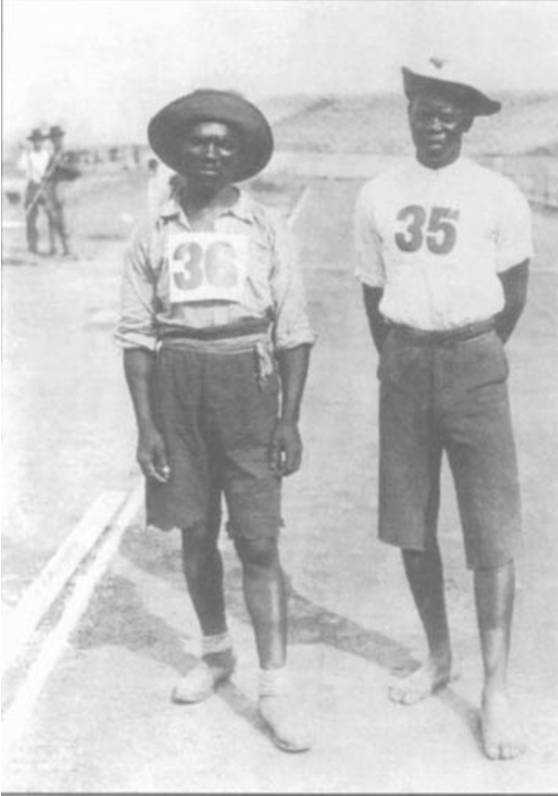
The two "Zulus" were not from Zululand, but more likely Tswanas from the Western Transvaal. Gen. Piet CRONJE was from Tswana country. After his surrender at the Battle of Paardeberg, his wife and some of his Black servants accompanied him into exile on St. Helena Island. There are photos of Len TAU as a Boer prisoner-of-war on St Helena. Their names were phonetically noted in many versions in the American newspapers and the official programmes. Their correct names were Len TAUNYANE and Jan MASHIANI. The only official photo of the two, held by the Missouri Historical Society, notes them incorrectly. The barefooted Len TAUNYANE should be the taller of the two, with the number 35 on his chest. The official programme stated that they had been messengers for the Boers during the war. The St. Louis Post Dispatch reported that they were dispatch runners for the British Army during the war.

The official programme for the marathon race, shows B.W. HARRIS in number one, and LENTAUW and YAMASANI in numbers 35 and 36 respectively. There were 38 competitors, of which only 32 took part. The marathon, over 40 kilometers / 24.85 miles, started on Tuesday 30 August and was run in hot and dusty conditions. The runners started in two rows, HARRIS being in the front row and the two Blacks in the back row. HARRIS dropped out of the race before having covered 15 miles. LENTAUW finished ninth and YAMASANI twelfth. According to the St. Louis Daily Globe-Democrat, LENTAUW was chased by a dog. It is possible that the Globe-Democrat confused the two runners. According to the race results published by Bill MALLON, Lentauw was 12th at five miles, 16th at 10 miles, 14th at 15 miles and 13th at 20 miles. Yamasani at five miles was 14th, at 10 miles he was 23rd, 15th again at 15 miles and in 14th place at 20 miles. The St. Louis Post-Dispatch reported they ran barefooted, but the official photo taken prior to the race, shows only LENTAU barefooted.

Len Tau, second from left, as a Boer prisoner-of-war on St. Helena Island
The participants in the tug-of-war event were Pieter WILLEMSE, Pieter LOMBARD, Johannes SCHUTTE, Paulus VISSER and Christopher WALKER. The team placed 5th, having lost to the Milwaukee Athletic Club.

At the International Olympic Committee meeting in July 1907 a motion that the four British colonies - the Cape of Good Hope, Natal, the Orange River Colony and the Transvaal - should be allowed to participate at the Olympic Games in London under the umbrella name of South Africa was tabled. This motion was accepted. The Union of South Africa was only formed three years later – on 31 May 1910. On 03 January 1908 a National Olympic Committee for South Africa was established, with its first president the mining magnate Henry NOURSE, an athlete in his youth.

Although time was short to organise enough funds to send a representative team to the Games in London, the South African Olympic Committee nominated a team of fifteen. This team consisted of seven athletes, four cyclists, three tennis players and a fencer. The team wore green with the Springbok emblem on the chest. More than 2000 athletes from 22 nations took part. Reggie WALKER, a 19-year-old from Natal, was South Africa's first gold medal winner, taking the 100 metres in 10,8 seconds. Marathon runner Charles HEFFERON won a silver medal.

Athletics:
Reggie Walker, South Africa's first
gold medal winner
1) Reginald (Reggie) Edgar WALKER was born on 16 March 1889 in Durban, the son of Samuel Ogden WALKER of Manchester. He died on 05 November 1951 in Durban. He was married to Sarah Ann WORSLEY of Manchester. He attended Boys Model School in Durban. The couple had one son and lived at 21 Cambridge Drive, Durban North.

2) Edward (Eddie) John DUFFY was born on 06 June 1883 in Ryno. He died on 19 October 1918 in Johannesburg.

3) Herbert (Bertie) Thorne PHILLIPS was born on 20 June 1883 in Pretoria, the son of George PHILLIPS. He died on 05 August 1977 in Pretoria.

4) Charles Archie HEFFERON was born on 15 January 1878 in Newbury, West Berkshire, England. He died on 15 March 1931/3 in Orangeville, Ontario, Canada. He came to South Africa during the Anglo-Boer War as a member of the South African Constabulary, and stayed on until 1909. At the time of the Games he worked as prison warden in Bloemfontein. After the Games he moved to Canada.

Charles Hefferon, South Africa's first silver medal winner
5) James Mitchell BAKER was born on 14 February 1878 in Glasgow, Scotland. He died on 14 December 1956 in George, Cape. He served in the Anglo-Boer War, First World War and Second World War. His medals included the C.B., C.B.E., and D.S.O. He was ADC to the King, Chief Staff Officer in South West Africa, seconded to British Army, served in Egypt, Flanders and France. He returned to South Africa in 1920. He was married to Madge GAYLARD.

6) Douglas (Doug) Annesley David STUPART was born on 30 March 1882. He died on 06 May 1951. He was married to Mabel BREMNER.

7) John (Vincent) Andrew de Villiers DUNCKER was born on 09 November 1884 in Wepener. His father was a German who immigrated to the Transvaal in 1880, where he married a Boer woman and had two sons and one daughter. After 10 years in Transvaal he lost his German civil rights and became a citizen of Transvaal, as did his children. After the Anglo-Boer War, in which he and his sons were involved, they returned to Germany in 1903 and again were granted German civil rights. When Vincent competed in the 1906 Olympics, he did so for Germany. After he finished his studies in 1907 he returned to South Africa and was entered for the 1908 Olympics for South Africa, but was unable to start due to a severe attack of rheumatism. He married Johanna GRILL. They divorced in 1919. He died in South Africa.

Cycling:
8) Floris (Floors) T. VENTER was born in 1886.

9) Philippus (Philip) Thomas FRYLINCK was born in 1886 in Graaff-Reinet. He died on 15 December 1908. He was married to Magdalena Susanna.

10) Frank SHORE was born in 1887.

11) Thomas (Harry) Henry Eddy PASSMORE was born on 19 June 1884 in Grahamstown, the son of John Frederick PASSMORE. He was an engineer by profession. He died on 08 May 1955 in Pretoria. He was married to Elizabeth SCHRODEL.

Tennis:
12) Harold (Harry) Austin KITSON was born on 17 June 1874 in Richmond, Natal. He died on 30 November 1951 in Umkomaas. He was married to Nora Ethel Frances WOOD.

13) Victor Reginald GAUNTLETT was born in 1884 in Forest Hill, Greater London, England. He died on 12 February 1949 in Witbank. He was married to Mabel Fanny PECK.

14) John P. RICHARDSON was born in 1874 in Madagascar.

Fencing:
15) Walter Percy / Price GATES was born in 1874. He died in 1939 in the Transvaal. He was married to Wilhelmina Mary HOREIS on 05 March 1901 in Cape Town. He was an Officer in the Mercantile Marine.