St. Louis planned a World’s Fair for 1904 to commemorate the purchase from France a century before, of the Louisiana territory. The International Olympic Committee gave Chicago the third Olympiad in 1904. After much discussion, Chicago agreed that it would be better if St. Louis hosted the Games too. On the Witwatersrand, a daily newspaper, the Rand Daily Mail dated 01 March 1904, ran a notice: "Boer War Exhibition, A chance for the unemployed! £4 per month and deductions." Those interested contacted the South African Boer War Exhibition Company in Pretoria. Soon there were 300 Boer veterans and 250 British / Colonial veterans signed up. They were to reconstruct at the World’s Fair two Anglo-Boer War battles and General DE WET's escape.

On Sunday 06 March 1904, a train departed from Braamfontein with 150 Boers, including Gen. CRONJE, for Delagoa Bay, where they boarded the Doune Castle. In Cape Town, the British contigent joined the ship, and they all left on 12 March for the USA. The number of participants is not accurately known. Some sources state 320, of which 200 were Boers, others say 500. In the Cape Times newspaper dated 21 Dec 1904, Arthur states there were 418 participants onboard, but this number did not include the Black recruits, said to be 24. The show's programme stated "all persons taking part in this military display, 600 in all, are men and women brought from various and distant parts of South Africa". It also stated that 200 were British / Colonial.
Gen. VILJOEN and Arthur sailed via London to St. Louis in November 1903. The Doune Castle arrived in Newport News, Virginia, on 06 April. They were met by a South African living in the USA, Luscombe SEARELLE, who was put in charge of finances. The group travelled to St. Louis by train. Britain had objected to the show via diplomatic routes. This caused some shareholders to pull out of the company. ventually, Henry J. MEYER of Pretoria and various St. Louis businessmen raised $100 000 to save the show, and the first show was finally held on 17 June.
On 08 August, the newspapers reported that R.W. HARRIS from "Aliwal South, Cape Town" was a well-known middle-distance runner and that he was in daily training for the Olympic marathon. Robert HARRIS was from Aliwal North, born in 1884.
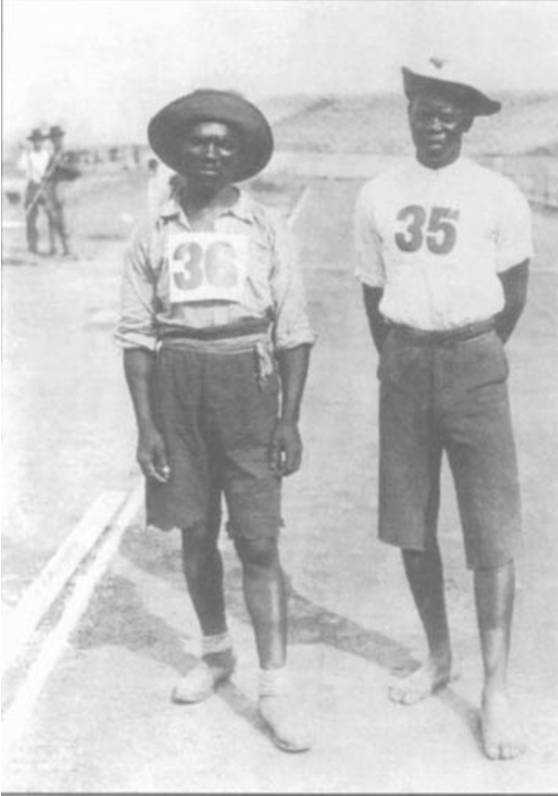
The official programme for the marathon race, shows B.W. HARRIS in number one, and LENTAUW and YAMASANI in numbers 35 and 36 respectively. There were 38 competitors, of which only 32 took part. The marathon, over 40 kilometers / 24.85 miles, started on Tuesday 30 August and was run in hot and dusty conditions. The runners started in two rows, HARRIS being in the front row and the two Blacks in the back row. HARRIS dropped out of the race before having covered 15 miles. LENTAUW finished ninth and YAMASANI twelfth. According to the St. Louis Daily Globe-Democrat, LENTAUW was chased by a dog. It is possible that the Globe-Democrat confused the two runners. According to the race results published by Bill MALLON, Lentauw was 12th at five miles, 16th at 10 miles, 14th at 15 miles and 13th at 20 miles. Yamasani at five miles was 14th, at 10 miles he was 23rd, 15th again at 15 miles and in 14th place at 20 miles. The St. Louis Post-Dispatch reported they ran barefooted, but the official photo taken prior to the race, shows only LENTAU barefooted.
 |
| Len Tau, second from left, as a Boer prisoner-of-war on St. Helena Island |
At the International Olympic Committee meeting in July 1907 a motion that the four British colonies - the Cape of Good Hope, Natal, the Orange River Colony and the Transvaal - should be allowed to participate at the Olympic Games in London under the umbrella name of South Africa was tabled. This motion was accepted. The Union of South Africa was only formed three years later – on 31 May 1910. On 03 January 1908 a National Olympic Committee for South Africa was established, with its first president the mining magnate Henry NOURSE, an athlete in his youth.
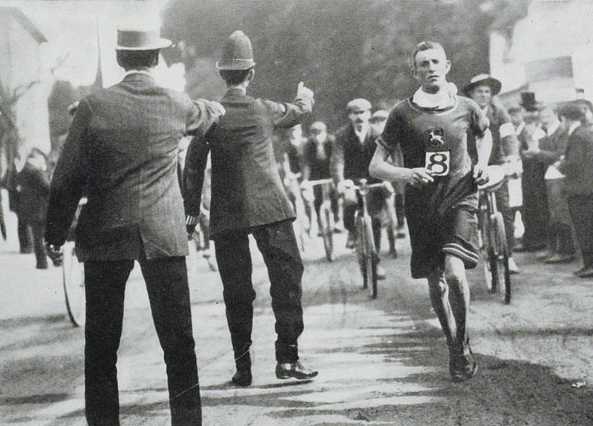
Although time was short to organise enough funds to send a representative team to the Games in London, the South African Olympic Committee nominated a team of fifteen. This team consisted of seven athletes, four cyclists, three tennis players and a fencer. The team wore green with the Springbok emblem on the chest. More than 2000 athletes from 22 nations took part. Reggie WALKER, a 19-year-old from Natal, was South Africa's first gold medal winner, taking the 100 metres in 10,8 seconds. Marathon runner Charles HEFFERON won a silver medal.
Athletics:
 |
| Reggie Walker, South Africa's first gold medal winner |
2) Edward (Eddie) John DUFFY was born on 06 June 1883 in Ryno. He died on 19 October 1918 in Johannesburg.
3) Herbert (Bertie) Thorne PHILLIPS was born on 20 June 1883 in Pretoria, the son of George PHILLIPS. He died on 05 August 1977 in Pretoria.
4) Charles Archie HEFFERON was born on 15 January 1878 in Newbury, West Berkshire, England. He died on 15 March 1931/3 in Orangeville, Ontario, Canada. He came to South Africa during the Anglo-Boer War as a member of the South African Constabulary, and stayed on until 1909. At the time of the Games he worked as prison warden in Bloemfontein. After the Games he moved to Canada.
 |
| Charles Hefferon, South Africa's first silver medal winner |
6) Douglas (Doug) Annesley David STUPART was born on 30 March 1882. He died on 06 May 1951. He was married to Mabel BREMNER.
7) John (Vincent) Andrew de Villiers DUNCKER was born on 09 November 1884 in Wepener. His father was a German who immigrated to the Transvaal in 1880, where he married a Boer woman and had two sons and one daughter. After 10 years in Transvaal he lost his German civil rights and became a citizen of Transvaal, as did his children. After the Anglo-Boer War, in which he and his sons were involved, they returned to Germany in 1903 and again were granted German civil rights. When Vincent competed in the 1906 Olympics, he did so for Germany. After he finished his studies in 1907 he returned to South Africa and was entered for the 1908 Olympics for South Africa, but was unable to start due to a severe attack of rheumatism. He married Johanna GRILL. They divorced in 1919. He died in South Africa.
Cycling:
8) Floris (Floors) T. VENTER was born in 1886.
9) Philippus (Philip) Thomas FRYLINCK was born in 1886 in Graaff-Reinet. He died on 15 December 1908. He was married to Magdalena Susanna.
10) Frank SHORE was born in 1887.
11) Thomas (Harry) Henry Eddy PASSMORE was born on 19 June 1884 in Grahamstown, the son of John Frederick PASSMORE. He was an engineer by profession. He died on 08 May 1955 in Pretoria. He was married to Elizabeth SCHRODEL.
Tennis:
12) Harold (Harry) Austin KITSON was born on 17 June 1874 in Richmond, Natal. He died on 30 November 1951 in Umkomaas. He was married to Nora Ethel Frances WOOD.
13) Victor Reginald GAUNTLETT was born in 1884 in Forest Hill, Greater London, England. He died on 12 February 1949 in Witbank. He was married to Mabel Fanny PECK.
14) John P. RICHARDSON was born in 1874 in Madagascar.
Fencing:
15) Walter Percy / Price GATES was born in 1874. He died in 1939 in the Transvaal. He was married to Wilhelmina Mary HOREIS on 05 March 1901 in Cape Town. He was an Officer in the Mercantile Marine.